Showing posts with label Research and Development. Show all posts

Robot Refrigerator

Although not a robot, Samsung is working on creating a refrigerator that will be the smartest refrigerator you will ever own. The reason for it being covered here on RobotsRule is because robots and A.I. (artificial intelligence) go hand in hand.

According to this Samsung spokesman Chae Hee-kook, the refrigerator will use RFID technology to track the items in your refrigerator. RFID stands for Radio-frequency identification. Tags are placed in many kinds of consumer goods that have RFID tags embedded in them allowing them to be tracked efficiently.

Using inventory levels set by the user, it will notify you when you are running low a particular item. Notification can happen in one of two intriguing ways:

  1. The refrigerator will be able to send a shopping list of required groceries directly to your cell phone. So you may find yourself in the near future getting a call from you refrigerator instead of your significant other, asking you to pick some things up on the way home!
  2. For participating grocery stores, it will be able to send your order directly to the store.

Given the second method, then theoretically if the store has a delivery service and your approval, you may find everything you need to make dinner tonight already waiting for you when you come home, without you having to do anything else but put the stuff away and cook it. Who knows, by the time the refrigerator is made available your home robot will do that for you! Other planned features include a recipe database that will suggest recipes based on what you have in the refrigerator, or will tell you what you need to buy if you want to make the meal for a recipe you like in the database.

Solar Power Refrigerator - A New Project

Refrigerators consume about 8% of the electric power used in American average homes and environmental temperature conditioning adds 44%. Most of these use electricity to generate the power required to operate refrigeration compressors but some use burning gas to obtain the energy to operate the refrigeration cycle.

There are about one hundred thousand portable refrigerators in use in the world which use kerosene for their power source. They are mainly used for vaccine storage in remote places without reliable electricity.

These flame powered refrigeration systems could be adapted to become solar powered refrigeration systems if the heated elements were exposed to concentrated beams of sunlight. A search of the internet didn’t come up with a permanent installation such as would be appropriate for a residential home or even an industrial setting but here at Greening the machine blog is a great site for saving energy.

The Tasman energy guy has some personal experience with various refrigerator systems and preferred the battery operated system powered by solar cells. Here the LPG Refrigeration Indonesia has several refrigerators based on gas which might be adaptable to solar use.

Gas cycle refrigerator Diagram


The diagram above is of the Hop-Hallstrom gas refrigerator designed in the 1920s and sold by Electrolux and discussed at greater length at Earth Garden.

To convert this to a solar powered system would only require a solar concentrator, such as a reflector, to concentrate the sun’s radiant energy upon the part labeled Generator-Boiler.

This adaptation could be ideally accomplished by exposing the generator-boiler located on the back of the refrigerator to the outside of the sun exposed side of the house and piping through the wall to a fully insulated compartment opening to the inside of the house.

A larger system of this type could be used for air-conditioning the entire house.

gas refrigerator dometic

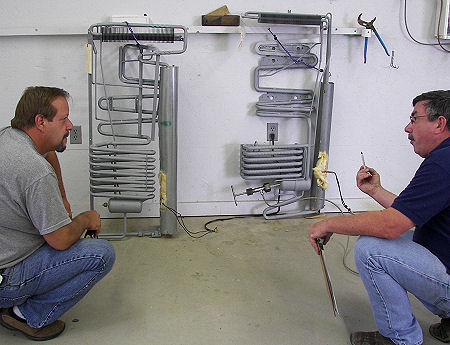
Comparing the Dometic and Norcold Cooling Units

The vertical pipe on the right in the photographs of these two refrigerator systems is the generator-boiler and in this photograph they seem to be discussing the electrical option of heating the working material within it.

As it is possible to use either burning gas or electricity to heat the material it would also be reasonable to use solar heat for that purpose. That would be easy enough to do if the columns were designed in such a way that a solar heatable surface were presented.


Nanotechnology Refrigerator

Researchers in a Finnish- Italian team (Helsinki University of Technology, Finland and Scuola Normale Superiore in Pisa, Italy) have observed that the electron can carry away heat.

They have built a small device where they found that heat is dissipated and therefore the device can act as a tinniest refrigerator.

Researchers from Helsinki University of Finland and Scuola Normale Superiore in Pisa, Italy have fabricated a tiny transistor similar to a transistor used in an IC.

Here super conducting electrodes although are similar to those used in a conventional transistor, however these electrodes are electrically insulated.

Researchers call this transistor a single electron refrigerator where the super conducting electrodes are connected to a 2mm long and 1/2 mm wide copper slab.

Another team of researchers from Singapore have also observed that heat can also carry information similar as electrons do in computers.

No Refrigerator Without Electricity - New Idea

Gas and Propane Refrigerators

If you own an RV or use a refrigerator where electricity is not available, chances are you have a gas- or propane-powered refrigerator.

These refrigerators are interesting because they have no moving parts and use gas or propane as their primary source of energy. Also, they use heat, in the form of burning propane, to produce the cold inside the refrigerator.

A gas refrigerator uses ammonia as the coolant, and it uses water, ammonia and hydrogen gas to create a continuous cycle for the ammonia. The refrigerator has five main parts:

* Generator - generates ammonia gas

* Separator - separates ammonia gas from water

* Condenser - where hot ammonia gas is cooled and condensed to create liquid ammonia

* Evaporator - where liquid ammonia evaporates to create cold temperatures inside the refrigerator

* Absorber - absorbs the ammonia gas in water

The cycle works like this:

1. Heat is applied to the generator. The heat comes from burning something like gas, propane or kerosene.

2. In the generator is a solution of ammonia and water. The heat raises the temperature of the solution to the boiling point of the ammonia.

3. The boiling solution flows to the separator. In the separator, the water separates from the ammonia gas.

4. The ammonia gas flows upward to the condenser. The condenser is composed of metal coils and fins that allow the ammonia gas to dissipate its heat and condense into a liquid.

5. The liquid ammonia makes its way to the evaporator, where it mixes with hydrogen gas and evaporates, producing cold temperatures inside the refrigerator.

6. The ammonia and hydrogen gases flow to the absorber. Here, the water that has collected in the separator is mixed with the ammonia and hydrogen gases.

7. The ammonia forms a solution with the water and releases the hydrogen gas, which flows back to the evaporator.

The ammonia-and-water solution flows toward the generator to repeat the cycle.


Are you really Interested in Refrigeration and Air Condiitioning?

If you are really interested in Refrigeration and if you really need to know more about Refrigeration and Air Conditioning, then mail me at hemachandiran1@gmail. For Final Year Projects and Ideas on Refrigeration and Air conditioning mail me to get more information.
